Internal Combustion Engines: Working Principles and Mechanisms,
Hello dear readers,
Today, we are going to explain the working principles and mechanics of internal combustion engines.
As you know, internal combustion engines are an essential part of our daily lives.
We commonly encounter these machines in vehicles. However, their applications are not limited to transportation.
They are also widely used in landfill gas facilities, generators, and various industrial applications.
That’s why, in this article, we will cover internal combustion engines at a beginner level.
By the end of this article, you will have a clear understanding of how they work.
Basic Principle
Internal combustion engines work as energy converters. Basically, they convert thermal energy into mechanical energy.
So, how does this process work?
First, the engine needs fuel to operate. The fuel provides the thermal energy required by the engine.
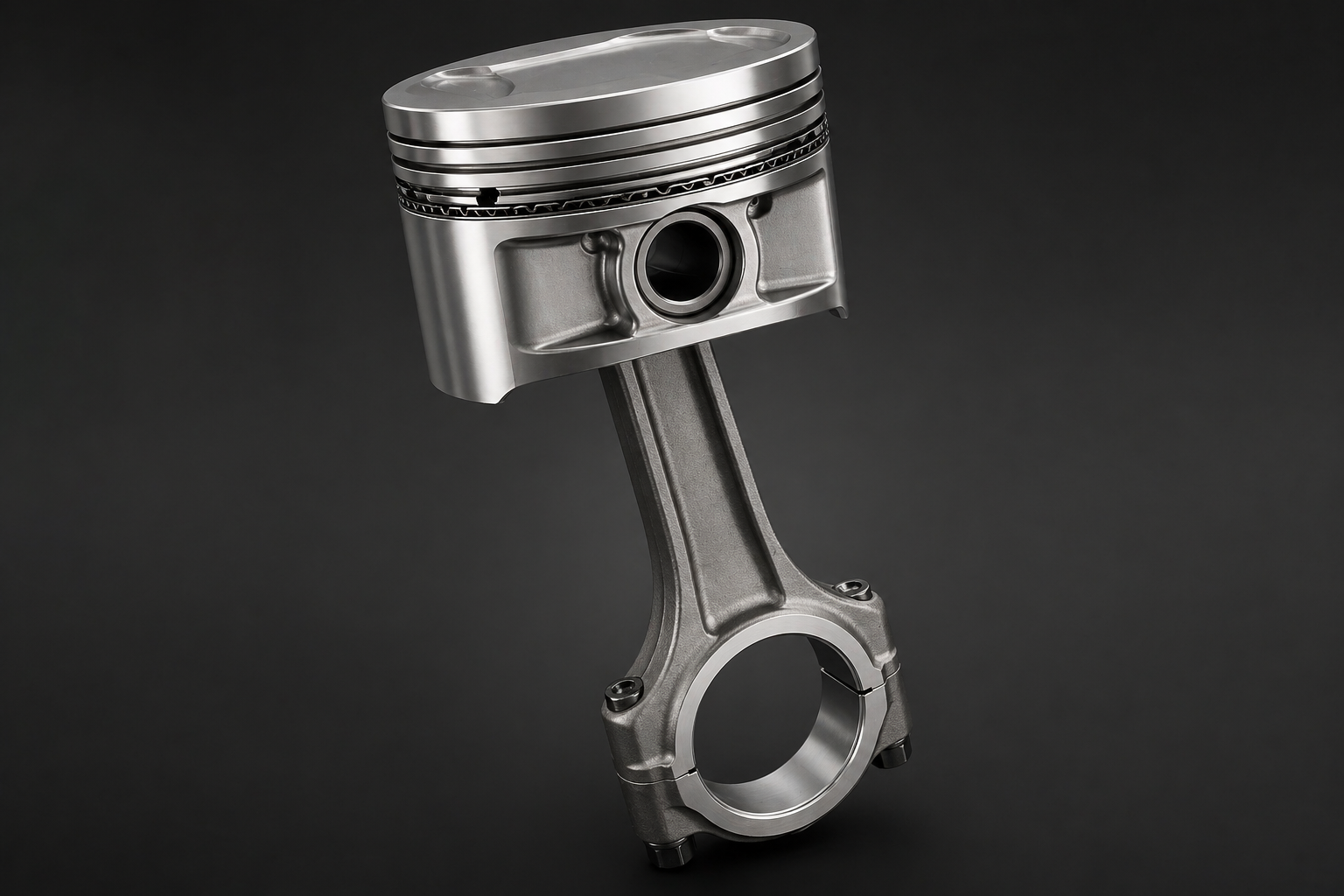
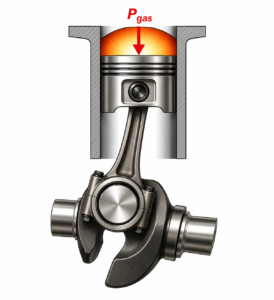
When the fuel is burned inside the engine, thermal energy is released. This energy creates high-pressure gases, which push the pistons and generate motion.
This piston movement is then transferred to the crankshaft, converting linear motion into rotational motion.
Internal combustion engines can have different numbers of cylinders, such as 3, 4, or 8. The process continues repeatedly in each cylinder. In Otto (gasoline) engines, combustion is initiated by a spark plug.
Main Components of Internal Combustion Engines
The main parts of an internal combustion engine include:
- Piston
- Spark Plug
- Injector (for diesel engines)
- Camshaft
- Intake Valve
- Exhaust Valve
- Timing Belt (or Chain)
- Connecting Rod
- Crankshaft
Combustion Process
Now, let’s explain the combustion process step by step.
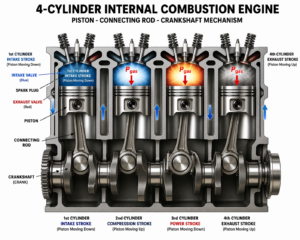
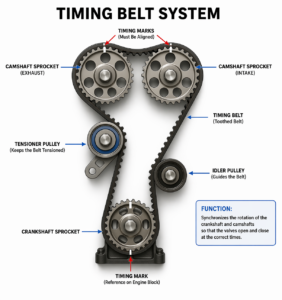
First, the fuel comes from the fuel tank. The intake valve opens with the help of the camshaft. The camshaft itself is driven by the crankshaft through a timing belt or chain.
When the intake valve opens, the air-fuel mixture enters the cylinder. At this stage, the piston moves downward.
Then, the intake valve closes, and the piston starts moving upward. During this movement, the air-fuel mixture is compressed.
When the piston reaches the Top Dead Center (TDC), the spark plug ignites the compressed air-fuel mixture.
As a result of combustion, a large amount of energy is released. This energy creates high-pressure gases that push the piston downward. This is called the power stroke.
When the piston reaches the Bottom Dead Center (BDC), the exhaust valve opens. As the piston moves upward again, it pushes the exhaust gases out of the cylinder through the exhaust valve.
After this, the cycle repeats continuously.
Conclusion
Internal combustion engines operate through a continuous cycle of intake, compression, combustion, and exhaust. Each component works in harmony to convert fuel into useful mechanical energy.
I hope everything is now clear and easy to understand.